
Most people don’t need another fitness program.
They need a way to make movement happen on days when the calendar is already full.
That’s why a new line of research has gotten so interesting: vigorous intermittent lifestyle physical activity (VILPA). It’s a mouthful, but the idea is simple:
> Very short bursts (often seconds to a couple minutes) of “hard” effort that happen inside normal life — climbing stairs fast, carrying groceries up a hill, hustling to catch the train.
A 2025 UK Biobank accelerometer study in British Journal of Sports Medicine looked specifically at people who reported no leisure-time exercise and found that even ~1–3 minutes per day of device-measured VILPA was associated with lower risk of major adverse cardiovascular events (MACE), especially in women. (Stamatakis et al., 2025)
This post explains what that study suggests (and what it doesn’t), why “micro-bursts” can be a reasonable tool for skeptical, busy people, and a 10–15 minute mini-plan you can try today.
What counts as VILPA (and what doesn’t)
VILPA is not “sneak in a workout.”
It’s more like turning a few moments you already have into slightly more intense moments.
Counts as VILPA (examples):
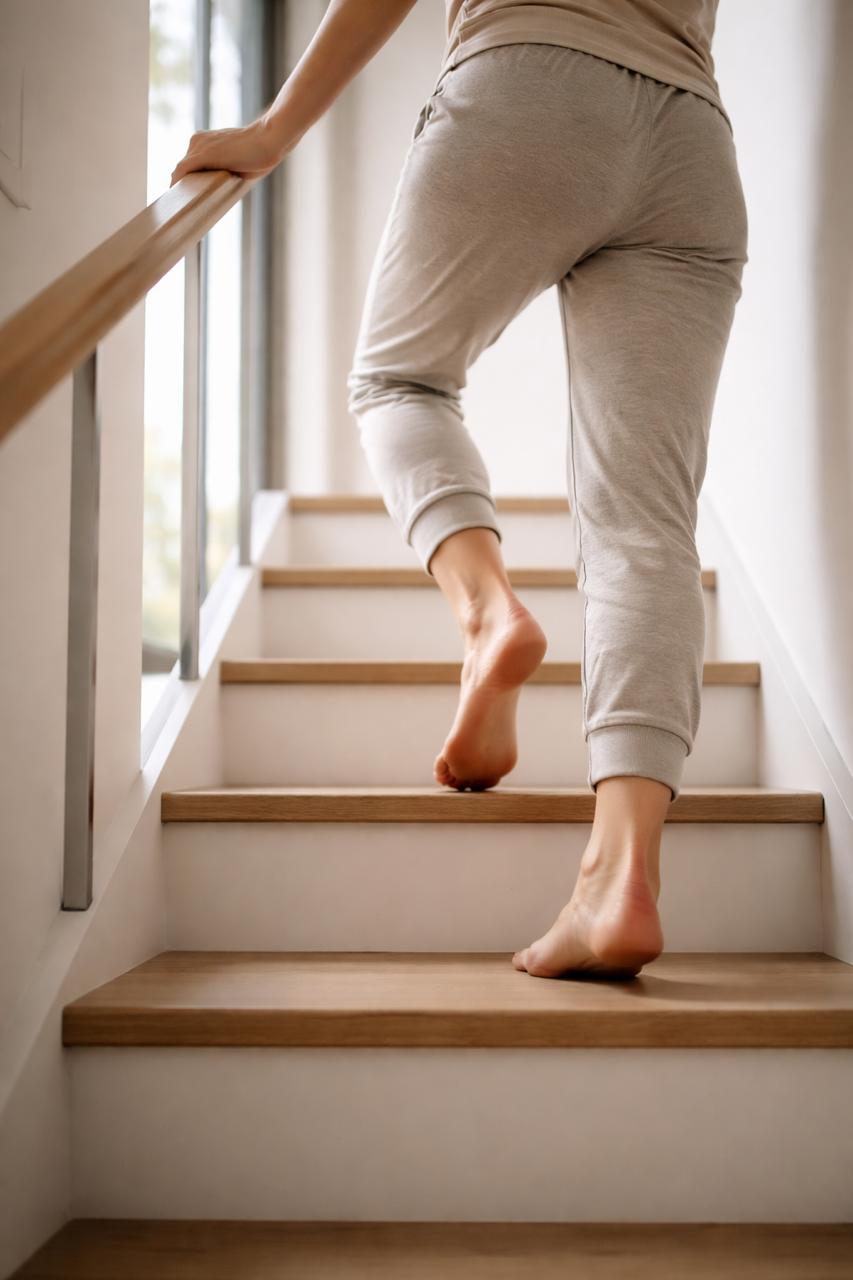
- Climbing a flight or two of stairs at a pace that makes you breathe noticeably harder.
- Walking uphill with purpose.
- Carrying something moderately heavy (laundry basket, groceries) up stairs.
- A 45–90 second “hustle” segment during your normal walk.
Doesn’t count (still good, just different):
- Gentle, easy strolling.
- Standing up once an hour (good for sedentary time, but not vigorous).
- A long walk where the intensity never changes.
A practical self-test: during the burst, you can still talk, but you probably don’t want to.
The new study, in plain English
Stamatakis and colleagues used the UK Biobank accelerometer sub-study and focused on non-exercisers — people who self-reported no leisure-time exercise and no more than one recreational walk per week.
They then used device data to estimate how much VILPA people accumulated in daily life and followed them for cardiovascular outcomes.
What they found
- In women, the relationship between daily VILPA and cardiovascular events looked close to linear: more VILPA, lower risk.
- In men, the curves were less clear, with less evidence of statistical significance.
The headline numbers (women, compared to no VILPA):
- Median ~3.4 minutes/day of VILPA was associated with lower risk of all MACE (HR ~0.55) and heart failure (HR ~0.33). (Stamatakis et al., 2025)
- Even ~1.2–1.6 minutes/day was associated with lower risk of all MACE (HR ~0.70), myocardial infarction (HR ~0.67), and heart failure (HR ~0.60). (Stamatakis et al., 2025)
That’s a striking signal. But there’s an important catch.
The catch: this is observational (so treat it like a strong clue, not a guarantee)
This study didn’t randomize people to “do VILPA” vs “don’t.” It measured what people already did.
That means:
- Causation is not proven. People who naturally move in short bursts might differ in other ways that also affect risk.
- Measurement is imperfect. Wrist accelerometers infer intensity from movement patterns. They’re useful, but not omniscient.
- UK Biobank isn’t the whole world. Participants tend to be healthier than average; results may not generalize perfectly.
So why take it seriously?
Because the pattern fits other evidence that intensity matters, and it offers a practical on-ramp for people who won’t do (or can’t do) formal workouts.
Why tiny intensity spikes could matter more than you’d expect
When you do something vigorous — even briefly — you create a bigger “disturbance” in your physiology than easy movement.
A few plausible reasons short vigorous bouts can punch above their time:
- Cardiorespiratory stress happens quickly. Heart rate and breathing ramp fast with intensity.
- Muscle recruitment is different. Hills/stairs recruit more muscle and higher force than flat walking.
- It may improve “reserve.” For older adults especially, the ability to move quickly (even for short periods) can reflect and build functional capacity.
This doesn’t mean everyone should be doing sprints.
It means: if you’re already walking, adding a few intentionally brisk segments may be the lowest-friction way to add intensity.
About the sex differences (and why you shouldn’t over-interpret them)
The paper’s most attention-grabbing detail is that the association looked clearer in women than men.
A few grounded possibilities:
- Different baseline activity patterns. If men in this “non-exerciser” group still get some vigorous movement in other ways, the contrast might be smaller.
- Different accelerometer classification. Device algorithms can behave differently across body sizes and movement styles.
- Random variability. When you slice data by sex and outcomes, some curves will look cleaner by chance.
The responsible takeaway is not “VILPA only works for women.”
It’s: if you’re currently doing little-to-no structured exercise, tiny bursts of intensity are plausibly useful and worth testing — for most people.
How to use this without turning your day into a new project
The failure mode is trying to “optimize VILPA.”
The win is to treat it like a sprinkle:
- You’re not changing your identity to “someone who does HIIT.”
- You’re adding 3–5 moments of purposeful effort to a day you’re already living.
Two design principles help:
1) Attach it to a predictable trigger
- The first time you take the stairs.
- The moment you leave home.
- The mid-afternoon slump.
2) Keep it short enough to be non-negotiable
Start with 30–60 seconds. Add more later.
Do this today (10–15 minutes total): the “3 micro-bursts” plan
If you try only one thing from this post, do this once today.
Step 1: Pick your burst type (choose one)
- Stairs: 1–3 flights, brisk but controlled.
- Hill: a 45–90 second uphill push.
- Flat walk: a 60-second “hustle” where you walk as fast as you safely can.
Step 2: Do three bursts, spaced out
Over the day, complete 3 bursts.
After each burst:
- Walk easy for 1–2 minutes.
- Let your breathing settle.
Total time: about 10–15 minutes, including recovery.
Step 3: Make it safer (especially if you’re deconditioned)
- If you have known heart disease, chest pain, unexplained shortness of breath, or you’re unsure: get medical clearance.
- Keep the first week at a “hard but controlled” effort — no all-out efforts.
- Prefer stairs with a handrail or a safe, familiar hill.
This is supposed to feel empowering, not punishing.
A subtle metric that helps: “minutes of huffing”
If you like tracking (without obsessing), try one metric for this concept:
Minutes per day where you notice your breathing.
It can be:
- 30 seconds, 3 times
- 90 seconds, twice
- 2 minutes, once
The point is not precision. It’s to make intensity visible.
If you use a step tracker app occasionally, you’ll usually see it show up as a short spike in pace or heart rate — but you don’t need gadgets to benefit.
How this fits with walking (and why it’s not an either/or)
VILPA isn’t a replacement for walking volume.
Think of it like this:
- Walking volume is the base: joint-friendly, repeatable, mood-supportive.
- Micro-bursts are seasoning: a small intensity signal that may matter for cardiovascular risk.
If your week is already packed, the best plan is often:
- Keep your normal walking.
- Add three micro-bursts on 3 days this week.
That’s not a transformation story. It’s a realistic habit.
A calm closing
If you’ve ever thought, “I don’t have time to exercise,” VILPA research offers a different framing:
You might not need time.
You might need moments.
Pick one moment today — one flight of stairs, one hill, one purposeful minute — and make it slightly more intense than usual.
Then go back to living your life.
Sources
Primary / peer-reviewed:
- Stamatakis E, et al. Device-measured vigorous intermittent lifestyle physical activity (VILPA) and major adverse cardiovascular events: evidence of sex differences. Br J Sports Med (2025). https://pubmed.ncbi.nlm.nih.gov/39467622/
Context / related evidence:
- CDC. Physical Activity Basics and Your Health. (Updated Dec 3, 2025). https://www.cdc.gov/physical-activity-basics/about/index.html
- American Heart Association. Walking for a healthy heart. https://www.heart.org/en/healthy-living/fitness/walking