
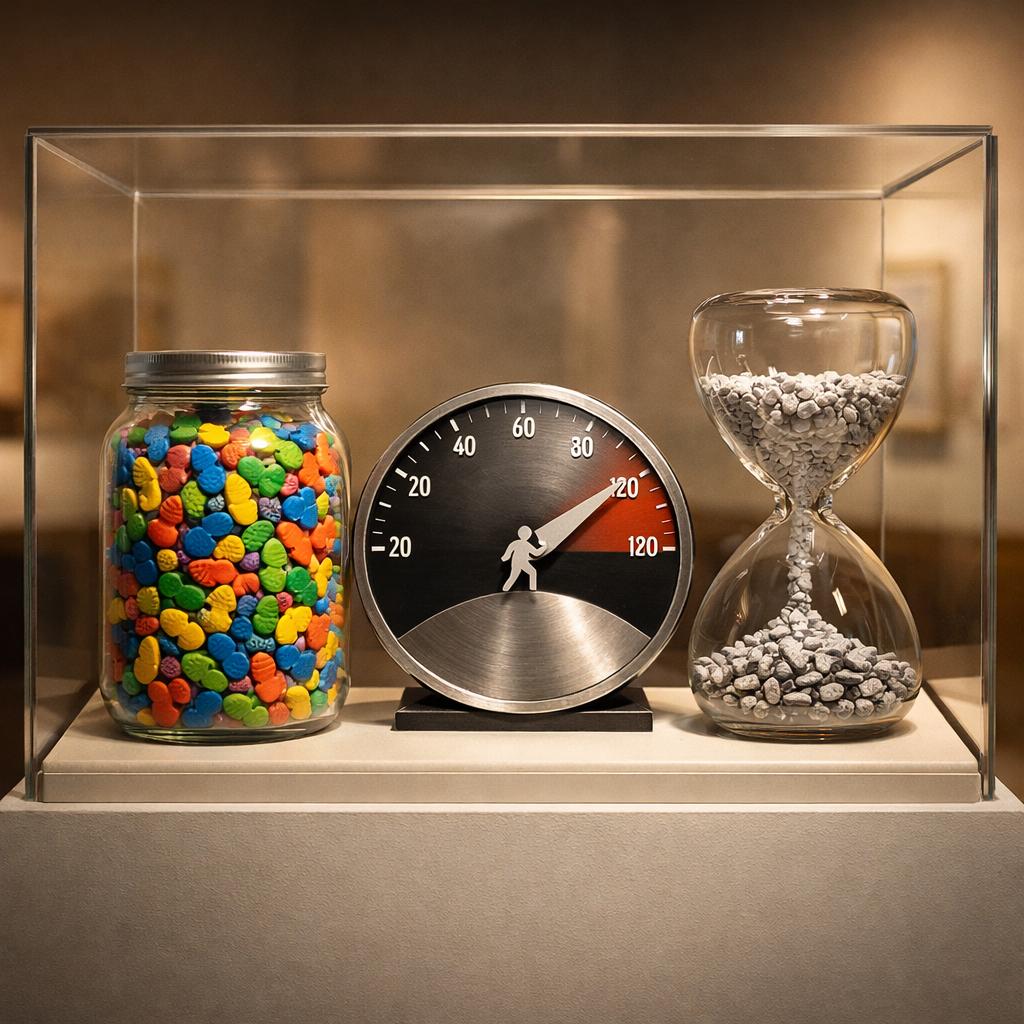
If you’ve ever looked at your daily step count and thought, “Was today a good day or just… a lot of shuffling?” you’re not being difficult — you’re noticing something real.
A 2026 review in Exercise and Sport Sciences Reviews makes the case that daily steps can be a practical public-health metric — not because a single number is magic, but because step data can reflect how much you moved, how intensely you moved, and how your movement is distributed across the day. That’s a bigger idea than “hit 10,000.” It’s also a better one. (Paluch et al., 2026)
This post is for busy, skeptical people who want step tracking to be useful — not a daily referendum on willpower.
The problem with treating your daily step count as a single score
Two days can show the same total steps and feel totally different:
- Day A: 7,500 steps in a few long walks, including a 12-minute brisk chunk.
- Day B: 7,500 steps scattered across chores and short indoor loops, none sustained.
Both days “count,” but they may not produce the same effects for blood pressure, glucose control, cardiorespiratory fitness, or mood — especially if Day B is mostly very light movement.
Public-health guidance has long focused on minutes of moderate-to-vigorous activity (often summarized as 150 minutes/week of moderate intensity). That’s still a solid anchor. The CDC also emphasizes that sitting less and doing any amount of moderate-to-vigorous activity brings benefits, even before you “meet the guideline.” (CDC, Benefits of Physical Activity)
Steps can complement that framework — but only if we stop asking one number to do three jobs.
Metric #1: Total steps (your movement volume)
What it captures: how much you moved overall.
Total steps are a decent proxy for total movement, especially in everyday life where you’re not logging every workout. Step totals also have two practical advantages:
- They’re hard to “game” for long. If your total is rising across weeks, something real changed.
- They include the unglamorous stuff. The hallway loops, the errands, the walk to pick up food — the movement most people actually can repeat.
What it doesn’t capture: intensity and distribution. A high step day can still be a mostly-sedentary day with one long walk, and a lower-step day can be physiologically “punchier” if it includes a brisk segment.
A grounded way to use it: treat total steps like a weekly average, not a daily grade.
- Pick a baseline week (no heroics).
- Increase your weekly average by 5–10% for two weeks.
- Hold or repeat.
That’s boring on purpose. Boring is how habits survive.
Metric #2: Brisk steps (your step intensity)
What it captures: whether some of your steps were done at a pace that likely counts as moderate intensity.
The phrase “step intensity” can sound like fitness-influencer nonsense, but it’s not. It’s just acknowledging a basic principle: pace changes stimulus.
A practical proxy is cadence (steps per minute). Different studies use different thresholds, and cadence varies by height, age, and fitness. The point isn’t a perfect cutoff; it’s that a brisk segment is qualitatively different from casual walking.
If you already track cadence or “active minutes,” great. If you don’t, here’s a simple rule:
- Brisk = you can talk in sentences but you wouldn’t choose to sing.
(Yes, that’s subjective. That’s also why it works across bodies.)
Why it matters: brisk movement is a time-efficient way to touch cardiorespiratory fitness, blood pressure, and glucose handling — without requiring you to become “a runner.” Walking can be an entry point that’s mechanically gentle and repeatable, which is part of why organizations like the American Heart Association keep promoting it as a simple cardiovascular habit. (AHA: Walking)
A grounded way to use it: aim for one brisk block most days.
- Start with 8–12 minutes.
- If that’s easy, add 2 minutes.
- If that’s hard, keep the minutes but make it “brisk-ish” (you’ll still adapt).
Metric #3: Breaks in sitting (your distribution)
What it captures: whether movement is sprinkled across the day rather than isolated to one workout.
Even if you hit a step goal, you can still spend most of your waking hours sitting. Distribution matters because long uninterrupted sitting is a distinct behavioral pattern — and breaking it tends to be more achievable than “add a workout.”
You don’t need an expensive standing desk or a perfect routine. The NIH’s National Institute on Aging frames physical activity for older adults (and honestly, for everyone) as something you can build into daily life in multiple forms — not just formal exercise. (NIH/NIA: Exercise and physical activity)
A grounded way to use it: target 3–6 tiny movement interruptions on workdays.
Examples that don’t require motivation:
- Walk while a kettle boils.
- One lap around your home before you sit back down.
- Take phone calls standing and pacing.
- Park 90 seconds farther away.
These aren’t “workouts.” That’s the point.
Putting it together: a simple 3-number dashboard
Here’s a dashboard that’s realistic for busy people and still physiologically meaningful:
- Total steps: your weekly average (movement volume)
- One brisk block: minutes per day you moved briskly (step intensity)
- Breaks: how many times you interrupted sitting with 60–180 seconds of movement (distribution)
You’ll notice this dashboard is not “step goal = pass/fail.”
That’s intentional. The goal is to get you a feedback loop that’s:
- Actionable (you know what to do next)
- Resilient (a bad day doesn’t nuke the whole system)
- Specific (you can improve one lever at a time)
This is the spirit of the 2026 review argument: steps are valuable because they’re measurable and behaviorally relevant — but they’re most useful when interpreted as more than a single total. (Paluch et al., 2026)
Common objections (and honest answers)
“Isn’t 10,000 steps made up?”
Yes — at least historically. The number popularized as marketing long before it was a research-based threshold.
But “made up” doesn’t mean “useless.” It means you should treat 10,000 as a round, motivating anchor, not a clinical target.
A better question is: what change is realistic for you, and can you keep it for 8 weeks? That’s where most health impact lives.
“If steps aren’t perfect, why track them?”
Because tracking isn’t about perfect measurement; it’s about behavioral steering.
If your tracking helps you:
- notice low-movement weeks early,
- add one brisk block,
- interrupt long sitting,
…then it’s doing its job.
“What if I can’t walk much?”
Then use the same logic with a different unit.
- Wheelchair propulsion minutes
- Seated marching
- Light cycling
- Short, frequent movement breaks that fit your body
Step counts are convenient, not morally superior.
Do this today (10–20 minutes): the “one brisk block + two breaks” mini-plan
This is designed to work even on a chaotic day.
Total time: ~12–18 minutes
1) Brisk block (8–12 minutes) Pick a route you can repeat (hallway loop counts). Warm up for 60 seconds easy, then walk briskly for the rest. Your only job is “a little uncomfortable, still controlled.”
2) Break #1 (2 minutes) Later today, set a timer for 2 minutes. When it goes off, stand up and walk anywhere. Don’t optimize it.
3) Break #2 (2–4 minutes) After your next meal or meeting, do 2–4 minutes of easy walking. Think of it as a reset, not a workout.
If you do only one thing: do the brisk block.
If you do two things: add one break.
That’s the ladder.
A subtle way to use Steps (optional)
If you use a step-tracking app (including Steps), consider creating a note or tag for “brisk block” days and “breaks” days, not just total steps. The goal isn’t more data — it’s better interpretation.
(If you don’t use an app, a calendar checkmark works fine.)
The calm takeaway
Your daily step count is not a verdict. It’s a clue.
If you treat steps as three signals — volume, intensity, and distribution — you get a system that can adapt to real life: travel days, sick days, parenting days, deadline days.
You don’t need a new identity. You need a few repeatable levers.
Sources
- Paluch AE, Matthews CE, Doherty A, Ekelund U, Evenson KR, Galuska DA, et al. Daily Steps as a Public Health Metric for Physical Activity Monitoring and Promotion. Exercise and Sport Sciences Reviews. 2026;54(1):15–25. https://pubmed.ncbi.nlm.nih.gov/41128511/
- CDC. Benefits of Physical Activity. https://www.cdc.gov/physical-activity-basics/benefits/index.html
- American Heart Association. Walking. https://www.heart.org/en/healthy-living/fitness/walking
- NIH National Institute on Aging. Exercise and physical activity. https://www.nia.nih.gov/health/exercise-and-physical-activity