
By Steps Team
Most of us already know that sitting all day isn’t great. The part that’s less obvious is what kind of “break” actually changes your physiology — and what kind mainly changes your conscience.
A small but unusually informative randomized crossover lab study did something clever: it compared the same energy “dose” of activity delivered in two different shapes.
- One: a single 30‑minute treadmill walk.
- Two: short, frequent breaks — either brief walks or brief squat sets — spread across a long sitting day.
Even with matched energy and time, the frequent breaks produced a bigger reduction in post‑meal glucose exposure, and the researchers found a plausible reason: more muscle activation in key muscles during repeated sit‑to‑stand transitions. In other words: not just “move more,” but turn more muscle on, more often.
This post is a skeptic-friendly guide to what that study does (and doesn’t) prove — and a simple 10–20 minute plan you can run today without changing your schedule.
What’s newly relevant here
Two trends have made this topic more practical in 2026 than it was a few years ago:
- The “exercise snacks” idea has matured from social-media meme to publishable evidence. A 2025 systematic review and meta-analysis in adults with obesity found that brief, frequent activity breaks can acutely reduce postprandial glucose and insulin compared with uninterrupted sitting — with hints that higher frequency and very short bouts may be especially useful (while still acknowledging heterogeneity and the need for longer trials).1
- Many people are trying to improve metabolic health without adding a full workout. If you’re busy, injured, traveling, caring for someone, or simply not in the mood, tiny, repeatable options matter.
The study that makes “squat breaks” worth taking seriously
The design (why it’s interesting)
In a randomized four‑arm crossover study of 18 overweight/obese young men, researchers compared an uninterrupted sitting condition with three “countermeasures” during 8.5 hours of mostly sitting:2
- SIT: uninterrupted sitting
- ONE: one 30‑minute walking bout (4 km/h)
- WALK: 3 minutes of walking (4 km/h) every 45 minutes (10 times)
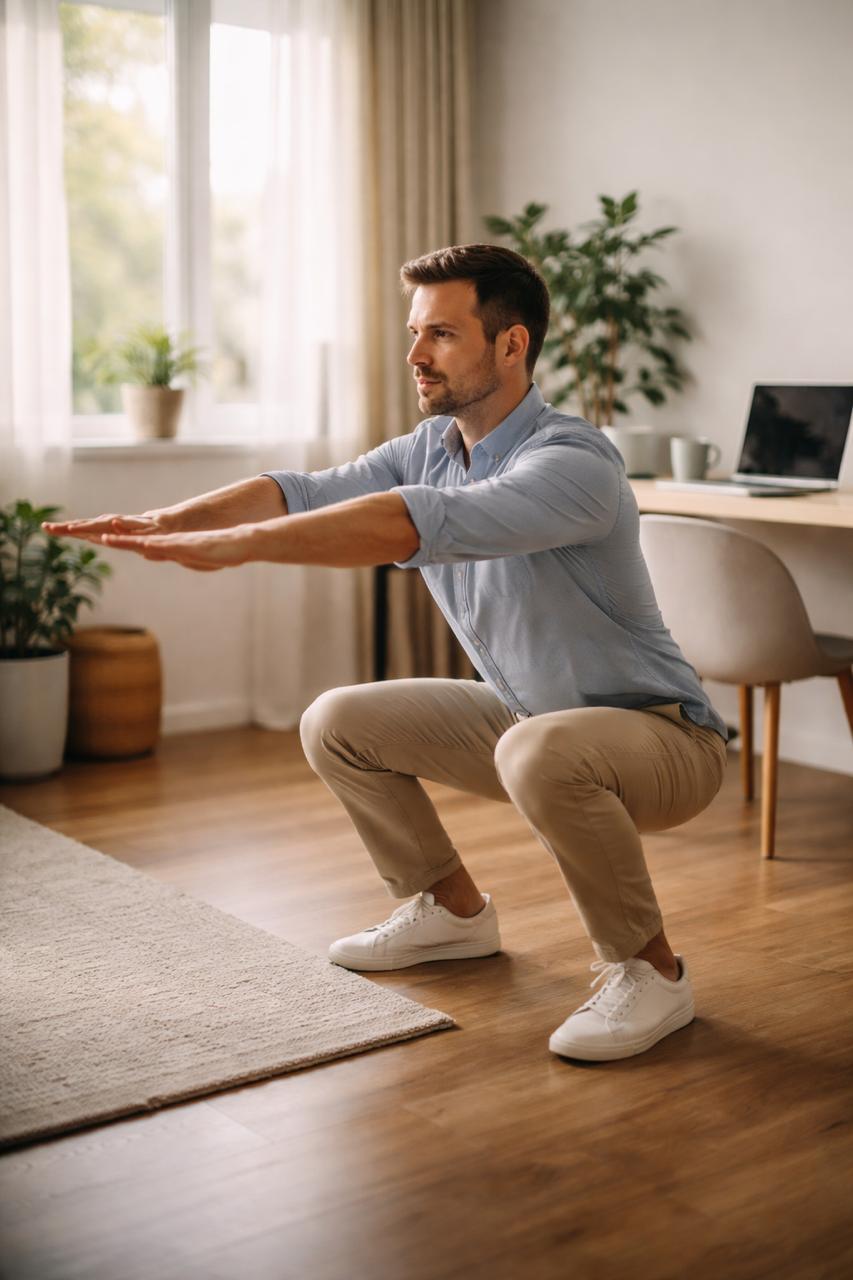
- SQUAT: a brief squatting break every 45 minutes (10 times), matched for energy/time with the walking breaks
They used continuous glucose monitoring to track the post‑meal glucose response, and they measured muscle activation patterns (EMG) in the quadriceps, hamstrings, and gluteal muscles.
The headline result (in plain English)
Compared with uninterrupted sitting, all activity conditions reduced postprandial glucose exposure.
But the key comparison was this:
- The short, frequent breaks (walking breaks or squat breaks) reduced postprandial glucose more than the single 30‑minute walking bout — even though energy/time were matched.2
That’s a big deal because it argues against the idea that “it’s all just calories burned.” The pattern matters.
The plausible mechanism (why squats might punch above their weight)
The study didn’t just stop at “glucose went down.” It asked what predicted the improvement.
They found that increased EMG amplitude in quadriceps and gluteal muscles was associated with larger reductions in post‑meal glucose exposure.2
If you’ve ever done even a small set of bodyweight squats, that should feel intuitive: compared with a very easy stroll, squats are a high-muscle, low-space move.
That doesn’t mean everyone should start doing heavy squats in their office.
It does mean that short, simple resistance-style breaks may be a practical alternative for people who:
- can’t leave their desk easily,
- live in bad weather,
- share a small space,
- feel awkward pacing,
- or want a “no shoes / no equipment” option.
What this does not prove (important if you hate fitness hype)
A few guardrails to keep this honest:
- It’s acute. We’re talking about glucose responses over hours, not diabetes incidence over years.
- It’s a specific sample. Young men with overweight/obesity in a controlled lab setting. It’s not automatically “everyone, everywhere.”
- It doesn’t say squats are superior to walking for overall health. Walking has broad benefits and tends to be easier on joints and more sustainable.
- It doesn’t justify extreme schedules. You don’t need a timer that hijacks your day.
The useful takeaway is narrower and more actionable:
> If you sit for long blocks, the distribution of movement matters, and brief, frequent muscle-activating breaks are a plausible way to improve your post‑meal glucose curve.
Why post‑meal glucose is a reasonable target (even if you’re not “metabolic”)
You don’t need to be diabetic for postprandial glucose to matter.
Post‑meal glucose spikes and the area under the curve are one way researchers quantify how hard your body has to work after eating. Over time, repeated high demands can be part of the pathway toward insulin resistance in susceptible people.
But here’s the calmer framing:
- We’re not trying to “optimize” your blood sugar like a day trader.
- We’re trying to nudge the curve in a better direction with something you can actually repeat.
If you want a public-health anchor, the CDC emphasizes that physical activity supports better function, mood, and sleep — and offers age-specific recommendations and practical tips for adding movement.3
“Squat breaks” vs “standing more”
A common workaround for sitting is standing desks.
Standing can be helpful, but standing still often doesn’t recruit the kind of muscle activity that changes glucose handling meaningfully. The squats/walking-breaks idea is different: it’s about repeated transitions and contractions.
If you can’t squat comfortably, you can still use the principle:
- sit-to-stand repetitions
- shallow chair squats
- stair steps
- wall push-ups
- calf raises
The goal isn’t a perfect exercise.
The goal is a small, repeatable “muscle on” interruption.
Do this today: the 12‑minute desk plan (10–20 minutes)
This is intentionally boring. Boring is repeatable.
Step 1 (2 minutes): pick your “break trigger”
Choose one:
- After you eat (best for post‑meal glucose)
- Between meetings
- When you refill water
Write it down. You’re designing a default.
Step 2 (8 minutes total): 4 mini-sets across your next 3–4 hours
Do 4 mini-sets (about 2 minutes each). Set a gentle timer or use natural transitions.
Each mini-set:
- 30 seconds easy walk or march in place
- 45 seconds chair squats (slow, controlled)
- Aim for a pace where you can still breathe through your nose
- 45 seconds recovery (slow walk, shake legs out)
If squats irritate your knees:
- reduce depth,
- do sit-to-stands from a chair,
- hold onto a desk for balance,
- or swap in calf raises.
Step 3 (2 minutes): “close the loop”
Right after the fourth mini-set, answer two questions:
- Was this annoying? (0–10)
- Would I do this again tomorrow? (yes/no)
If the answer is “no,” adjust the plan until it becomes “yes.”
That’s not weakness; it’s how habits work.
The longer-term version (if you want to keep it)
If you like the 12‑minute plan, here’s a simple progression that doesn’t require more willpower:
- Week 1: 4 mini-sets on 2 days
- Week 2: 4 mini-sets on 3 days
- Week 3: keep frequency, add a fifth mini-set once
You’re not “training.” You’re changing the texture of your sitting day.
A subtle Steps note (optional)
If you track steps, you can use a step counter as a cue rather than a score: the point isn’t to chase a number — it’s to notice long flat lines and break them up.
Close: the calm version of “more movement”
You don’t need a heroic workout to do something meaningful today.
If you sit for long stretches, try this principle once:
> More muscle, more often — in tiny doses you can repeat.
Your blood sugar curve won’t send you a thank-you note. But your afternoon energy and your future self might.
Sources
- Chang Y, Wang H, Zhang X, Liu H. Acute effects of exercise snacks on postprandial glucose and insulin metabolism in adults with obesity: a systematic review and meta-analysis. Front Nutr. 2025. PMID: 41356824. https://pubmed.ncbi.nlm.nih.gov/41356824/
- Gao Y, et al. Enhanced muscle activity during interrupted sitting improves glycemic control in overweight and obese men. Scand J Med Sci Sports. 2024 Apr;34(4):e14628. PMID: 38629807. https://pubmed.ncbi.nlm.nih.gov/38629807/
- Centers for Disease Control and Prevention. Physical Activity Basics and Your Health. Updated Dec 3, 2025. https://www.cdc.gov/physical-activity-basics/about/index.html
- American Heart Association. Walking. https://www.heart.org/en/healthy-living/fitness/walking
- NIH News in Health. Opportunities Abound for Moving Around. May 2015. https://newsinhealth.nih.gov/2015/05/opportunities-abound-moving-around
Chang et al., 2025 (systematic review/meta-analysis), PMID: 41356824.
Gao et al., 2024 (randomized crossover trial), PMID: 38629807.
CDC Physical Activity Basics, updated Dec 3, 2025.