
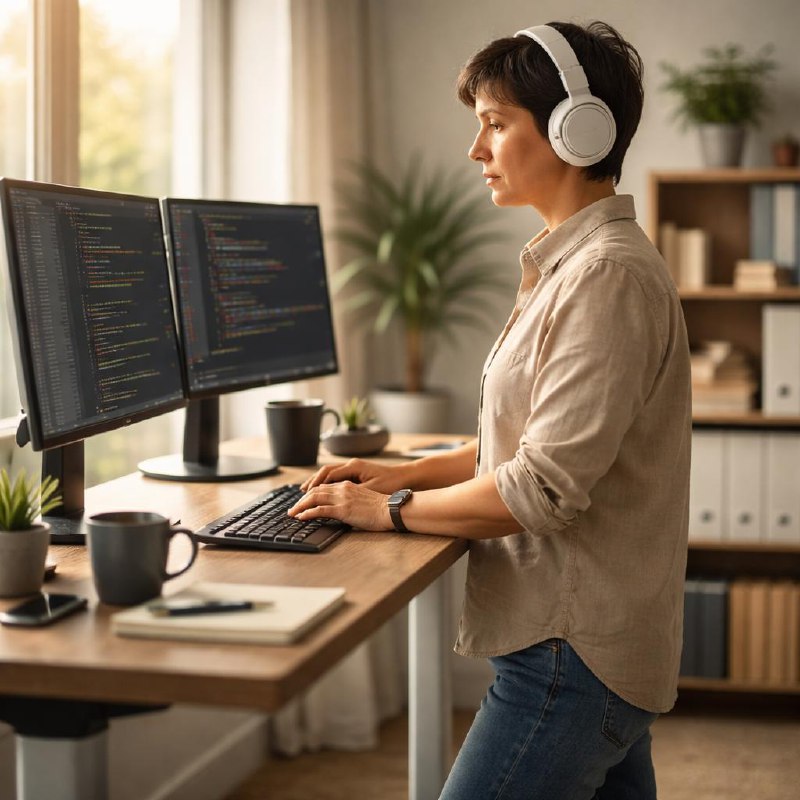
You can exercise regularly and still spend most of your day sitting. That’s not a moral failure — it’s the default design of modern work.
The interesting question isn’t “Should we sit less?” (we probably should). It’s what actually works for reducing sedentary time in a way people can keep doing — not for a week, but for months.
A workplace trial with 24‑month follow‑up looked at exactly that: a multilevel program designed to help employees stand and move more at work — and then checked whether any of it lasted. The takeaway isn’t a new magic number of steps. It’s a set of levers that make movement easier to repeat.
(SEO note: primary keyword is sedentary time.)
What the research looked at (in plain language)
The study followed workers in a real workplace where the goal was simple: reduce sedentary time during the workday. Instead of relying only on willpower, the intervention used multiple layers — think environment + norms + reminders — that could plausibly fit into a typical office.
A key detail: the researchers didn’t stop at “short-term results.” They assessed outcomes again much later, at 24 months, which is rare and useful. Many programs look great at 8–12 weeks. Fewer survive the calendar.
Here’s the grounded point for busy people: if an approach still shows signal at month 24, it’s more likely to be compatible with real life.
Why “sit less” isn’t the same as “work out more”
A lot of fitness advice collapses everything into one bucket: activity. But your day usually has at least three buckets:
1) Moderate-to-vigorous exercise (the workout) 2) Light movement (walking to a meeting, stairs, errands) 3) Sedentary time (sitting or lying down while awake)
If you’re skeptical, that’s healthy. The evidence doesn’t say sitting is “the new smoking.” But a big sedentary block can be its own problem even if you also exercise — especially for blood sugar handling after meals and overall cardiometabolic risk.
So the target isn’t “be perfect.” It’s: stop making sitting the default for every single hour.
What tends to stick at month 24
Long follow-up results are messy by nature — people change jobs, offices rearrange, priorities shift. That’s exactly why they’re valuable.
Across long-term behavior-change research, a few themes show up again and again:
1) Friction beats motivation
If moving requires a full routine change — special shoes, a dedicated time slot, a specific location — you’ll do it when life is calm and skip it when life is not.
What tends to persist is movement that:
- starts in under 30 seconds
- doesn’t require equipment
- has a clear trigger (a meeting ends; you refill water; you hit send)
In other words: reduce the “activation energy.”
2) The environment quietly wins
When the environment supports movement, people move without thinking about it.
Examples that often matter more than motivational posters:
- a standing-height table available for quick tasks
- a printer or water station that isn’t three feet away
- a culture where taking a 2-minute walk isn’t treated like slacking
If your environment fights movement, you’ll need constant self-control. That’s not a plan — it’s a tax.
3) Replace the pattern, not just the minutes
Many people try to “get their steps in” with one big walk and then sit immobile for hours.
The problem isn’t only the total sitting time; it’s the unbroken stretches. A day of identical step counts can look very different depending on whether steps are sprinkled throughout the day or packed into one session.
A practical goal is to interrupt long sitting blocks with short movement breaks. You don’t need to be dramatic about it.
The boring mechanics that make movement breaks easier
If you want this to work without hype, focus on mechanics:
Choose a trigger you already do
Pick one of these and attach a 60–120 second movement break:
- after every video call
- after you send an email that required focus
- when you refill water or coffee
- when you stand up to use the bathroom
The trigger is the secret. The movement is the easy part.
Keep the movement “light” on purpose
Light intensity is underrated because it doesn’t feel like exercise. That’s the point.
- walk a loop in your home/office
- climb one flight of stairs and come back
- do 10 bodyweight sit-to-stands from a chair
If you make every break a workout, you’ll resist starting.
Track the behavior you’re actually changing
If your goal is “sit less,” a step target can help — but it’s indirect.
Try tracking one of these for a week:
- number of movement breaks per day (e.g., 6–10)
- longest sitting block (try to shrink it)
- time of day you’re most stuck sitting (often mid‑afternoon)
If you want a gentle nudge, an app like Steps can help you notice your patterns — but it’s not required. The intervention is behavioral, not technological.
Do this today: the 12-minute anti-sitting mini-plan (no gear)
This is designed for a skeptical, busy day. Total time: about 10–20 minutes, split across the day.
Step 1 (1 minute): Set two triggers
Pick two triggers for today:
- trigger A: “when my first meeting ends”
- trigger B: “after lunch”
Write them down. If you don’t, you’ll improvise — and improvisation is where habits go to die.
Step 2 (8 minutes total): Four 2-minute movement breaks
Do four breaks of 2 minutes each. Options:
- 2-minute brisk walk
- 1 minute stairs + 1 minute easy walk
- 20–30 chair sit-to-stands at a calm pace
Keep it light-to-moderate. You should be able to speak full sentences.
Step 3 (2 minutes): Break your longest sitting block
Look at your calendar and find the longest “head-down” work stretch.
Insert one interruption:
- stand up, walk to a window, look far away for 20 seconds
- walk to refill water
- do a slow loop around your space
This is the break that changes your day’s pattern.
Step 4 (1 minute): Make tomorrow easier
Before you end your workday, do one tiny setup:
- leave a water bottle somewhere that requires you to stand to reach it
- move your charger so you must stand up to plug in
- put your shoes by your desk
You’re not trying to “biohack” yourself. You’re trying to remove excuses.
What to expect (and what not to expect)
If you do this for one day, you probably won’t feel transformed. That’s fine.
More realistic expectations:
- a slightly easier time concentrating mid‑afternoon
- less stiffness in hips/back
- fewer hours lost to the “I’ve been sitting forever” slump
Not realistic:
- instant fat loss
- guaranteed blood pressure changes in a week
The promise is smaller and better: a routine you can repeat, which is what the long-term data is really about.
A calm way to think about “enough”
When the goal is reducing sedentary time, the win condition isn’t perfection.
A calm target to experiment with:
- aim to interrupt sitting every 30–60 minutes
- keep breaks short enough that they don’t feel like an event
- build toward consistency, not intensity
If you’re already active, you’re not “starting from zero.” You’re just reshaping your workday pattern.
Closing: the real opposite of sitting
The opposite of sitting isn’t running.
It’s getting up.
If you want a movement habit that survives month 24, make it easy to start, easy to repeat, and socially normal. Then let the boring consistency do what heroic motivation rarely does.
Sources
- Leonard KS, Larouche M, Mitchell NR, et al. Maintenance effects of a multilevel workplace intervention to reduce sedentary time: twenty-four-month follow-up of the group randomized clinical trial “Stand and Move at Work”. Int J Behav Nutr Phys Act. 2025;22(1):39. doi:10.1186/s12966-025-01731-w. https://pubmed.ncbi.nlm.nih.gov/40197229/
- Quinn TD, Perera S, Conroy MB, et al. Impact of sedentary behaviour reduction on desk-worker workplace satisfaction, productivity, mood and health-related quality of life: a randomised trial. Occup Environ Med. 2025;82(2):61-68. doi:10.1136/oemed-2024-109868. https://pubmed.ncbi.nlm.nih.gov/40011044/
- Mat Azmi ISM. Interrupted sitting at work can alter postprandial glucose, triglycerides and non-esterified fatty acids (NEFA). Med J Malaysia. 2025;80(Suppl 6):98-105. https://pubmed.ncbi.nlm.nih.gov/41447008/
- Safdar NZ, Alobaid AM, Hopkins M, et al. Short, frequent, light-intensity walking activity improves postprandial vascular-inflammatory biomarkers in people with type 1 diabetes: The SIT-LESS randomized controlled trial. Diabetes Obes Metab. 2024;26(6):2439-2445. doi:10.1111/dom.15564. https://pubmed.ncbi.nlm.nih.gov/38558524/
- Centers for Disease Control and Prevention. Physical Activity Basics and Your Health. Updated Dec 3, 2025. https://www.cdc.gov/physical-activity-basics/about/index.html