
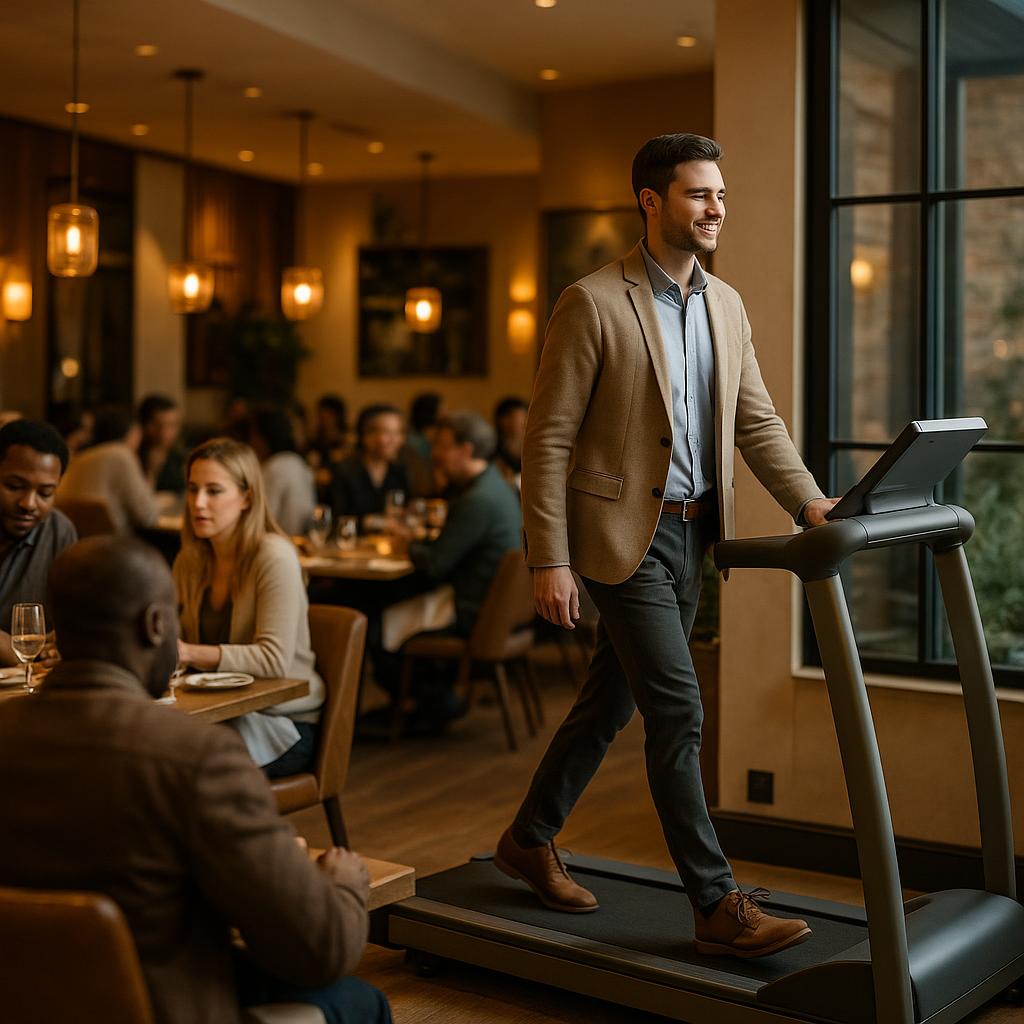
Most fitness advice treats movement like an event: a workout you schedule, sweat through, and forget.
But a growing slice of research points to something far less dramatic: a short, easy walk soon after you eat can meaningfully reduce the size of your post‑meal blood sugar “spike.” Not forever. Not in every person. Not as a substitute for the basics. Just enough to be worth doing—especially if you’re busy, skeptical of hype, and sitting a lot.
If you want one “small lever” that tends to pay off quickly, this is it.
Why post‑meal blood sugar matters (even if you’re not diabetic)
After you eat, glucose rises in your bloodstream. Your pancreas releases insulin to help move that glucose into muscle and liver cells.
Two things are easy to miss:
- Spikes are normal. You don’t need to fear them.
- Bigger, longer spikes add wear-and-tear. Over time, frequent high excursions can be a sign your body is working harder to keep things in range—especially if you’re trending toward insulin resistance or prediabetes.
Insulin resistance and prediabetes are common, and many people have them without knowing it.5 The goal here isn’t to obsess over numbers—it’s to make one habit that nudges the system in a healthier direction.
What the evidence says about walking after you eat
A systematic review and meta‑analysis in Sports Medicine looked at controlled studies comparing exercise before vs after a meal and how it affects post‑meal glucose levels.1 Across studies, post‑meal activity—often simple walking—tended to reduce postprandial glucose excursions, with effects that were generally strongest when the movement happened soon after eating.
A separate systematic review in Sports Medicine examined breaking up long sitting with brief bouts of standing or light walking.3 That line of evidence points in the same direction: small, frequent movement can improve short‑term cardiometabolic markers, including measures related to glucose and insulin.
More recently, a 2025 meta‑analysis focused specifically on adults with obesity and quantified the acute effects of “exercise snacks”—brief, frequent interruptions to prolonged sitting—on postprandial glucose and insulin.2 The authors reported reductions in glucose and insulin area‑under‑the‑curve when sitting was interrupted regularly.
Three caveats that keep this honest:
- These are mostly short‑term studies. The signal is about acute responses after meals or after sitting—not guaranteed long‑term outcomes.
- Effects vary. Meal composition, baseline fitness, and metabolic health matter.
- Walking is not a magic shield. It helps—but it doesn’t erase the rest of your day.
Still: the pattern is consistent enough to treat a post‑meal walk as a reasonable bet.
The mechanism, in plain English: muscles as a “glucose sink”
You don’t need to exercise hard for your muscles to help manage glucose.
When you walk, your leg muscles contract repeatedly. That creates a demand for fuel.
- Some of that fuel can be glucose in the blood.
- Muscle contractions can also increase glucose uptake through pathways that are partly independent of insulin.
The result: a smaller peak and often a quicker return toward baseline—particularly when you move while glucose is rising.
This is one reason timing can matter. A walk “sometime today” is good. A walk in the window after you eat can be strategically good.
How much walking, how soon, and how hard?
Here’s the pragmatic answer for real life:
- Start: within ~15 minutes after finishing the meal (earlier is usually better).
- Duration: 10 minutes is a great default.
- Intensity: easy to moderate—you can talk in full sentences. You’re not trying to “burn off” the meal. You’re trying to nudge metabolism.
If 10 minutes feels unrealistic, scale down:
- 5 minutes still counts.
- If you can’t leave your building, do a lap routine: stairs (slowly), hallway loops, or even marching in place while you tidy.
If you want to scale up, keep it boring:
- 15–20 minutes is fine.
- If you’re already active, you don’t need to chase intensity here. Consistency beats heroics.
What about “exercise snacks” during the workday?
If your day is packed with meetings, the second‑best option is to break up sitting.
A common research pattern is a short bout of light walking every ~30 minutes.32 The point isn’t the exact interval—it’s the repetition. Think of it as metabolic flossing: small, frequent clean‑ups that prevent gunk from building up.
Who benefits most (and who should be careful)
This habit is especially worth trying if you:
- Sit most of the day.
- Have a strong family history of type 2 diabetes.
- Know you have prediabetes, insulin resistance, or metabolic syndrome.
- Notice a “food coma” after lunch and want a calmer afternoon.
Be cautious and talk to a clinician if you:
- Use insulin or medications that can cause hypoglycemia.
- Have chest pain, unstable heart symptoms, or severe shortness of breath.
- Are recovering from an injury where walking is limited.
For most people, moderate physical activity like brisk walking is generally safe, and building gradually is a sensible approach.4
Make it work with a skeptical brain: 5 practical friction‑reducers
If you’re busy, the barrier isn’t knowledge—it’s execution. Try these:
- Pre‑decide the trigger. “After lunch, I walk.” Not “I’ll walk more.”
- Shrink the loop. Put shoes by the door, or pick an indoor route that takes zero setup.
- Use a default route. A 10‑minute loop you can do anywhere: out-and-back, three blocks, or a parking‑lot circuit.
- Pair it with something pleasant. One podcast segment, a phone call, or a single favorite song list.
- Don’t negotiate on tired days—downgrade. If you’re wiped, do 3–5 minutes. Keep the habit alive.
Do this today (10–20 minutes): the Post‑Meal Walk Mini‑Plan
Pick one meal today—lunch is often easiest.
Step 1 (1 minute): Choose your “walk window.”
- Set a timer for 10 minutes after you finish eating.
Step 2 (8–12 minutes): Walk easy.
- Keep it comfortable.
- If you’re inside: hallway loops, stairs at a gentle pace, or marching while you reset your kitchen.
Step 3 (1 minute): Write one sentence.
- “After lunch I feel: ___.”
- Optional: note focus/energy 60 minutes later.
Step 4 (optional, 5 minutes): Add one sitting break.
- Later in the afternoon, do 3 minutes of light walking between meetings.
That’s it. No trackers required.
(If you do track steps, this is one of the rare times when steps can be used as a behavioral cue: after the meal, add a quick 800–1,200 step “cap.” Keep it low‑stakes.)
The calm conclusion
The post‑meal walk isn’t trendy because it isn’t dramatic. It’s just physiology.
You eat.
Your blood sugar rises.
Your muscles can help.
If you’re looking for a grounded habit that fits a real schedule, start there. Ten minutes today is enough to learn whether it changes how you feel—and whether it’s worth repeating tomorrow.
Sources
- Engeroff T, Groneberg DA, Wilke J. After Dinner Rest a While, After Supper Walk a Mile? A systematic review with meta‑analysis on the acute postprandial glycemic response to exercise before and after meal ingestion. Sports Medicine (2023). https://pubmed.ncbi.nlm.nih.gov/36715875/
- Chang Y, Wang H, Zhang X, Liu H. Brief, frequent interruptions to prolonged sitting (“exercise snacks”) and postprandial glucose/insulin in adults with obesity: systematic review and meta‑analysis. Frontiers in Nutrition (2025). https://pubmed.ncbi.nlm.nih.gov/41356824/
- Buffey AJ, Herring MP, Langley CK, Donnelly AE, Carson BP. Breaking up prolonged sitting with standing/light walking: systematic review and meta‑analysis. Sports Medicine (2022). https://pubmed.ncbi.nlm.nih.gov/35147898/
- CDC. Benefits of Physical Activity (updated Dec 4, 2025). https://www.cdc.gov/physical-activity-basics/benefits/index.html
- NIDDK (NIH). Insulin Resistance & Prediabetes. https://www.niddk.nih.gov/health-information/diabetes/overview/what-is-diabetes/prediabetes-insulin-resistance
Engeroff T, Groneberg DA, Wilke J. Sports Med. 2023;53(4):849–869. https://pubmed.ncbi.nlm.nih.gov/36715875/
Chang Y, Wang H, Zhang X, Liu H. Front Nutr. 2025;12:1708301. https://pubmed.ncbi.nlm.nih.gov/41356824/
Buffey AJ, Herring MP, Langley CK, Donnelly AE, Carson BP. Sports Med. 2022;52(8):1765–1787. https://pubmed.ncbi.nlm.nih.gov/35147898/
CDC. Benefits of Physical Activity. https://www.cdc.gov/physical-activity-basics/benefits/index.html
NIDDK. Insulin Resistance & Prediabetes. https://www.niddk.nih.gov/health-information/diabetes/overview/what-is-diabetes/prediabetes-insulin-resistance