
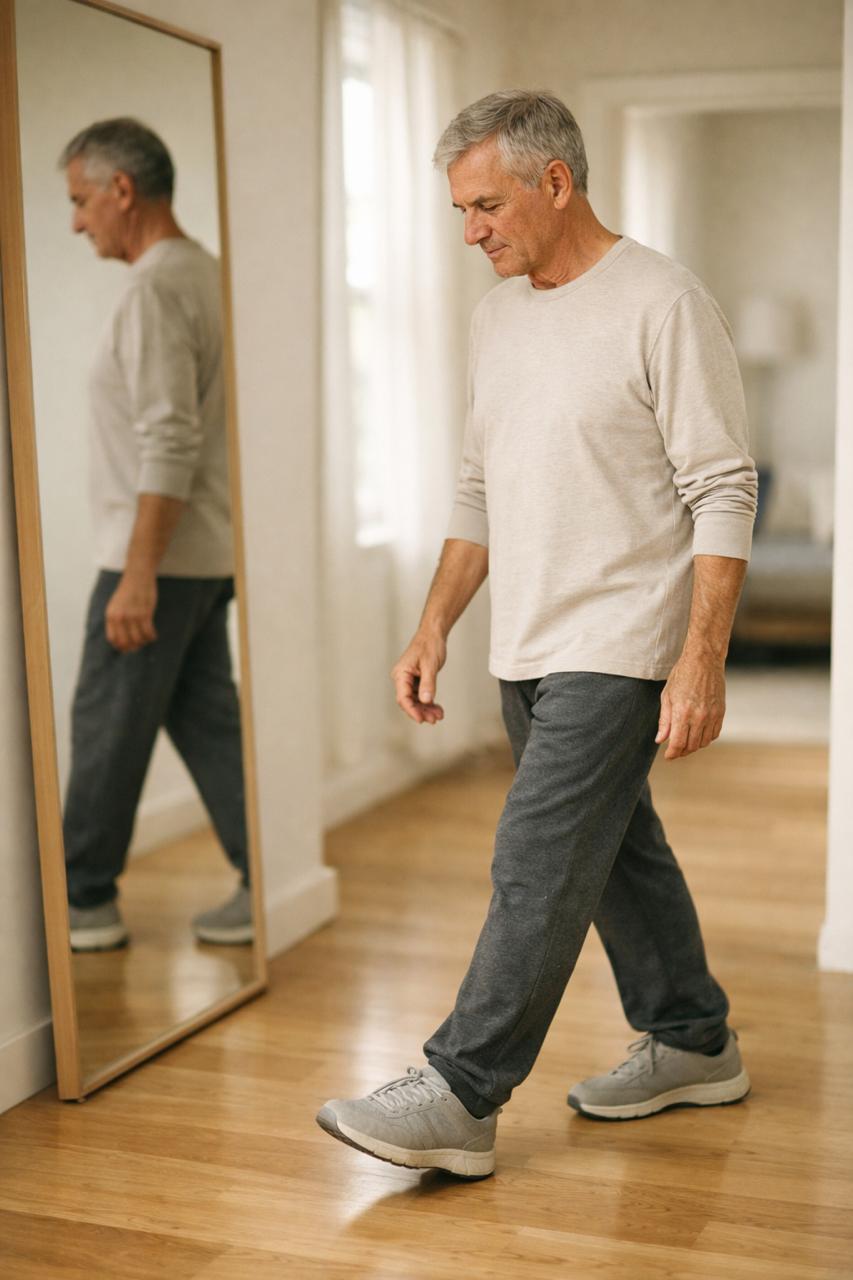
If you have knee osteoarthritis (OA), most advice collapses into two unhelpful extremes: “rest it” or “push through it.” Neither is a great long‑term strategy.
A 2025 clinical trial tested something more specific: a short program that combines lower‑limb strengthening, balance training, and gait retraining using visual feedback—basically, practicing how you walk while you can see what you’re doing (a mirror, a screen, or a simple feedback setup). In older women with knee OA, the program improved pain and function and also improved measures related to balance and perceived fall risk. The idea is practical: if the knee is sore and the movement pattern has drifted, you don’t only need “more movement.” You may need better movement—in a way you can repeat.
This post is the skeptic’s guide to what the study actually showed, what it can’t prove, and how to steal the useful parts as a 10–20 minute plan you can do today.
The study hook (and why it’s interesting now)
The trial asked a clean question: Does adding balance + gait training with visual feedback to a strengthening program help older women with knee OA?
Why it’s interesting now:
- Knee OA is everywhere (and rising with aging populations). The “just walk more” message often backfires when walking hurts.
- Falls risk is a real constraint for many people with knee pain, and fear of falling can shrink activity more than pain itself.
- Most OA advice focuses on what to do (strengthen, walk, lose weight) and less on how to move (gait mechanics you can actually practice).
In this 2‑month program, the OA group improved pain and function vs controls, and the intervention was rated as feasible and acceptable. That combination—helpful + doable—is rarer than it should be.
(Primary source: Souza et al., 2025. See Sources.)
What “visual feedback” means (in plain English)
Visual feedback doesn’t have to be fancy.
It means you’re not guessing whether your movement looks the way you intend. You’re getting a real‑time cue such as:
- walking next to a mirror,
- watching yourself on your phone camera (propped up safely),
- or following a simple line/target on the floor (tape) while you walk.
Why it might help: when pain shows up, people often unconsciously change how they walk—shorter steps, more trunk lean, different foot loading, “protective” patterns. Some of those adaptations can be useful short term. Some become sticky and increase load where you don’t want it.
Visual feedback is a way to make the pattern visible, so you can gradually shape it—without obsessing.
What the trial found (and what it didn’t)
Here’s the grounded read of the paper:
What it found
In older women with knee OA, after ~2 months of a combined program (strength + balance + gait with visual feedback), the OA group showed:
- Less pain and better function on common OA questionnaires (WOMAC, Lequesne).
- Improvements in walking capacity (6‑minute walk) and Timed Up and Go.
- Better scores on a falls‑risk awareness measure.
- Changes in plantar load distribution during gait (a biomechanical proxy for altered walking mechanics).
Just as important: participants rated the program as highly acceptable and feasible.
What it didn’t prove
- It doesn’t prove that visual feedback alone was the magic ingredient. The program bundled multiple components.
- It doesn’t prove it prevents falls or slows structural progression of OA.
- It studied older women in one setting; results may not generalize perfectly.
Still, the overall message is strong: for knee OA, movement quality + strength + balance is a sensible “package,” and you can borrow the principles without needing a clinic.
The mechanism that makes sense (without hype)
OA pain isn’t only “wear and tear.” It’s a mix of:
- joint structure,
- inflammation,
- muscle capacity,
- coordination,
- and how the nervous system interprets threat.
Strength training helps because stronger legs can reduce the relative effort of everyday tasks (stairs, chairs, walking). Balance training helps because stability changes how confident you are moving through the day—and confidence changes behavior.
Gait retraining with feedback adds a third angle: it treats walking like a skill, not just a volume goal.
That’s a useful mental model for busy people: you don’t have to “grind out” painful walks. You can do short, calm practice that makes your next walk feel easier.
Do this today: the 12–18 minute “knee-friendly walking skill” mini‑plan
This is designed to be low‑drama. You should feel worked but not wrecked. If you have sharp pain, swelling, or instability, scale down or talk with a clinician.
Setup (1 minute)
- Put on supportive shoes.
- Stand near a stable counter/wall.
- If you’ll use a phone for feedback, prop it securely at hip height where it won’t fall.
Part A — Strength (6 minutes)
1) Sit‑to‑stand (2 minutes)
- From a chair, stand up and sit down with control.
- Aim for 6–10 reps.
- Make it easier: use hands lightly on the chair.
- Make it harder: pause for 1 second standing; slow the lowering.
2) Supported heel raises (2 minutes)
- Hold the counter lightly.
- Rise onto the balls of your feet; lower slowly.
- 10–15 reps.
3) Side‑step “mini‑band” walk (optional) or no‑band side steps (2 minutes)
- If you have a mini‑band, place it above knees.
- Take small side steps, keep knees tracking over toes.
- 8–12 steps each direction.
Part B — Balance (4 minutes)
4) Single‑leg stand (2 minutes total)
- 20–30 seconds per side, repeat once.
- Hold the counter with one finger if needed.
5) “Clock taps” (2 minutes)
- Stand on one leg.
- Tap the other foot lightly forward/side/back like points on a clock.
- 5–8 taps per direction per side.
Part C — Gait skill with visual feedback (5–7 minutes)
6) Two-minute ‘practice walk’ with a cue (2 minutes)
Pick one cue (not all of them):
- Quiet feet: try to land softly.
- Even steps: match left and right step length.
- Tall posture: imagine a string lifting the top of your head.
Walk back and forth in a hallway.
7) One-minute “line walk” (1 minute)
Put a strip of tape on the floor (or imagine one). Walk along it at an easy pace.
8) Two minutes of normal walking (2 minutes)
Now remove the cue. Walk normally and notice if anything feels smoother.
The key rule
Finish thinking: “I could do that again tomorrow.” That’s the point.
How to make it work on a busy week (without turning it into a project)
- Two levers matter most: frequency and comfort. Do the mini‑plan 3–4 days this week.
- Keep walks short but frequent while pain is flaring. Pain often responds better to “small exposures” than to a single heroic session.
- If you have stairs, treat them as a dose: one extra trip per day beats a big stair workout that triggers soreness.
If you’re tracking steps, use it as a gentle nudge, not a scorecard. The program above counts because it’s practice that makes future steps easier.
When to get help (quick red flags)
Consider professional input if you have:
- the knee “giving way,”
- true locking,
- major swelling after small activity,
- night pain you can’t explain,
- or pain that’s worsening week to week.
A physical therapist can also help you personalize the visual feedback piece—often with very simple tools.
A calm close
Knee OA doesn’t require perfect biomechanics or perfect consistency. It does reward a specific kind of effort: small, repeatable practice that builds strength and steadiness while reducing threat.
If you do the 12–18 minute mini‑plan today, you’re not just “getting exercise.” You’re making walking easier to choose tomorrow.
Sources
- Souza TS, et al. Effect of Rehabilitation Program for Muscle Strength, Balance, and Gait Retraining with Visual Feedback in Older Women with and Without Knee Osteoarthritis: Clinical Trial. J Pers Med. 2025. https://pubmed.ncbi.nlm.nih.gov/41440992/
- CDC. Physical Activity Basics and Your Health. (Updated Dec 3, 2025). https://www.cdc.gov/physical-activity-basics/about/index.html
- American Heart Association. Walking. https://www.heart.org/en/healthy-living/fitness/walking
- NIH MedlinePlus Magazine. Articles about Exercise. https://magazine.medlineplus.gov/topic/exercise