
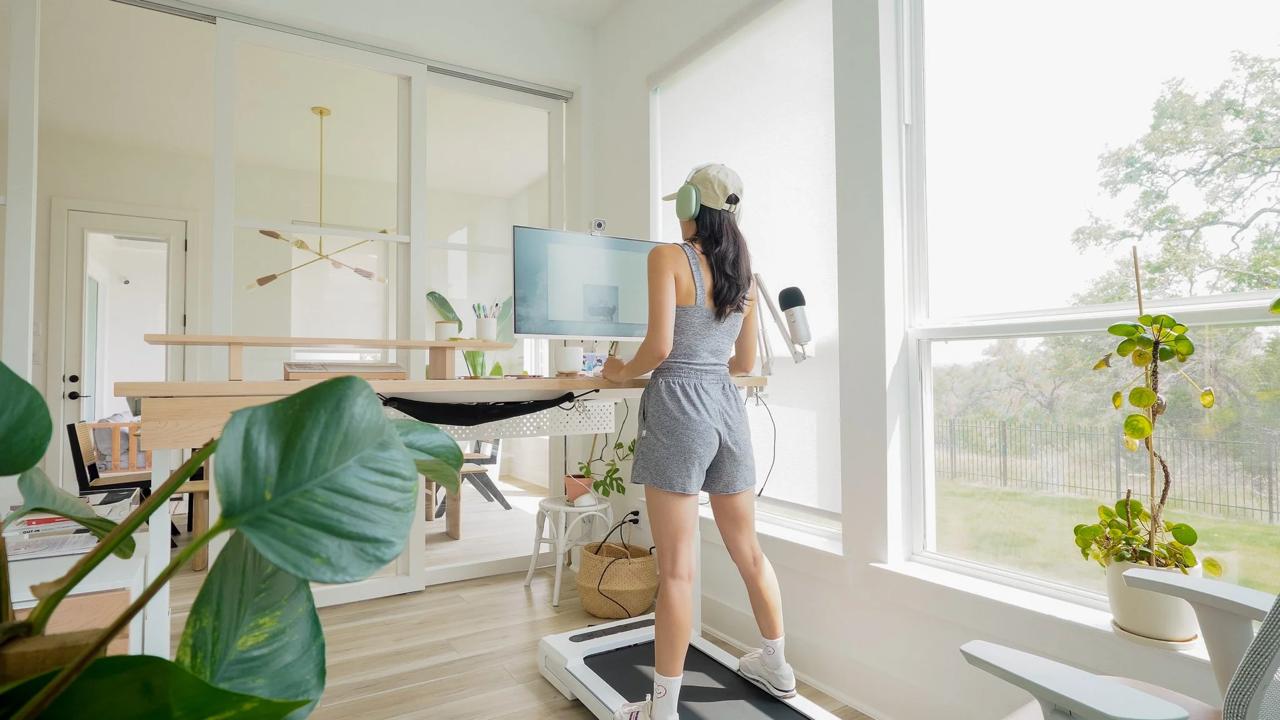
Most of us know the feeling: you’ve been sitting for a while, your body is fine, but your brain gets… sticky. The usual advice is “stand up” or “go for a walk.”
A randomized crossover trial in older adults put a surprisingly specific version of that advice to the test: 2‑minute walking breaks every 30 minutes during a 3‑hour sitting period — and in one condition, those breaks were dual‑task (walking while doing a simple cognitive task). The researchers measured cognitive performance and cerebral blood‑flow velocity before and after. They found improvements in verbal fluency, a small improvement in set‑shifting, and an increase in cerebral blood‑flow velocity compared with uninterrupted sitting. That’s not a miracle. But it’s a useful, low‑hype idea you can copy.
In this post, we’ll translate what the study actually did, what it can’t prove, and a 10–20 minute mini‑plan that fits into a normal day.
What the new study did (and why it’s interesting now)
The trial was published online in 2025 in Geroscience and enrolled 27 healthy older adults (average age ~69). Each participant completed three separate 3‑hour sessions on different days:
- Control: sit for 3 hours without breaks.
- Single‑task walking breaks: every 30 minutes, take a 2‑minute walk.
- Dual‑task walking breaks: every 30 minutes, take a 2‑minute walk while doing a cognitive task (a “dual‑task” condition).
Before and ~10 minutes after each session, they assessed several cognitive tests (including verbal fluency and Trail Making tasks) and measured cerebral blood‑flow velocity (CBFv).
Why this matters now: there’s been a steady drumbeat of evidence that sedentary time isn’t just “not exercising.” It has its own physiology, and short activity breaks can meaningfully change acute markers like post‑meal glucose. But for many people — especially as we age — the daily motivator isn’t blood sugar; it’s mental clarity and feeling sharp.
This trial ties the “break up sitting” idea to the brain in a concrete, testable way.
Primary source: Cunha PM et al., 2025 (Geroscience) randomized crossover trial. PubMed
What “dual‑task walking” means in real life
“Dual‑task” sounds like lab jargon, but you’ve probably done it:
- Walking while talking (in person or on a call)
- Walking while mentally planning your next meeting
- Walking while naming items in a category (“fruits,” “cities,” “tools”)
- Walking while doing a simple memory task (e.g., recalling a grocery list)
The point isn’t to multitask with email. It’s to add a light cognitive load during the movement break — enough to engage attention, but not enough to be stressful.
A useful way to think about it:
- Single‑task break: “Move blood and joints.”
- Dual‑task break: “Move blood and joints and nudge the brain’s ‘work mode’ back online.”
The study can’t tell us whether dual‑task is better than single‑task for everyone, or whether it’s only helpful for certain tasks. But it raises a practical question: if you’re already going to take a short walking break, should you sometimes pair it with a small cognitive challenge?
What the trial found (translated into non‑hype)
The headline is not “walking breaks prevent dementia.” The trial looked at acute changes over hours, not disease outcomes over years.
Here’s what it did suggest:
1) Verbal fluency improved after both kinds of walking breaks compared with uninterrupted sitting. Verbal fluency tests are essentially: “how quickly can you pull words from memory under a rule?” That’s a mix of retrieval speed, attention, and executive function.
2) A small improvement in set‑shifting (switching attention between tasks) showed up. That’s the kind of cognitive flexibility you feel as “less stuck.”
3) Cerebral blood‑flow velocity increased after the walking‑break conditions compared with the control condition.
Taken together, this fits a common‑sense story: prolonged sitting can be a cognitive drag, and even short movement breaks may help the brain return closer to baseline.
Important caveats:
- The sample was small (n=27), and most participants were women.
- It’s one lab‑style protocol: 3 hours, breaks every 30 minutes, 2‑minute walks.
- The cognitive tests are proxies — they’re useful, but they’re not “real‑world productivity.”
Still, the protocol is so lightweight that it’s worth borrowing.
Why movement breaks might affect the brain (without overclaiming)
There are a few plausible, non‑mystical pathways:
1) Cerebral blood flow and vascular function
Brain tissue is metabolically expensive. When you shift from static sitting to walking, you change heart rate, blood pressure patterns, and vascular shear stress — all of which can influence blood flow dynamics.
We shouldn’t assume that a short increase in cerebral blood‑flow velocity automatically means “better brain health.” But it’s a reasonable intermediate marker to watch.
2) Arousal and attention
Many cognitive tasks are sensitive to under‑arousal (sleepiness, monotony) and over‑arousal (stress). A brisk 2‑minute walk is a clean way to nudge arousal upward without caffeine.
3) Posture, breathing, and sensory input
Standing and walking change breathing mechanics, engage core and leg muscles, and provide more sensory stimulation than sitting. These are subtle inputs, but over a long day they add up.
4) “Task switching” practice
Dual‑task walking may act like a micro‑dose of controlled task switching: move, coordinate, think. For some people, that might “unstick” attention.
Again: plausible, not proven.
Who this idea is for (and who should keep it simpler)
This approach is most relevant if:
- You sit in blocks of 60+ minutes (desk work, driving, meetings).
- You notice mental sluggishness rather than body discomfort.
- You want something that’s not a full workout, but isn’t just standing up.
Keep it simpler if:
- You’re prone to dizziness, balance issues, or falls.
- You’re recovering from illness or injury.
- You’re in a context where dual‑task walking could be unsafe (stairs, uneven sidewalks, crowded streets).
Safety rule: dual‑task means “gentle cognitive load,” not “look at your phone while walking.”
Do this today (10–20 minutes): the “2×5 + 5” break plan
You don’t need to reproduce “every 30 minutes for 3 hours.” Instead, borrow the shape of the intervention.
The plan
Pick one 2–3 hour block today when you’re likely to sit (work, reading, TV).
1) Set two timers for the block: one at ~30–45 minutes, one at ~90 minutes. 2) When the first timer hits, do a 5‑minute easy walk.
- First 2 minutes: normal pace.
- Next 2 minutes: slightly brisk.
- Last 1 minute: easy.
- Walk somewhere safe and boring (hallway, flat sidewalk).
- Choose one task:
- Category fluency: name as many “foods that start with S” as you can.
- Planning: outline the next 3 actions you’ll take after you sit down.
- Recall: reconstruct yesterday’s dinner or your last grocery trip.
3) When the second timer hits, do a 5‑minute dual‑task walk.
4) At the end of the block, do a final 5‑minute “reset” walk with no task — just breathe.
Total time: 15 minutes (or 10 minutes if you skip the final reset).
How to know it worked
Don’t look for a dramatic mood shift. Look for one of these small signals:
- You return to your seat and start faster.
- You make fewer “tiny mistakes” (re-reading, losing your place).
- Your eyes feel less strained.
If none of that happens, you still got three low-cost movement doses.
The skeptical takeaway
This study doesn’t prove that walking breaks protect long‑term cognition. It does something more modest and more useful: it suggests a repeatable pattern that can make a sitting-heavy day feel better — especially for older adults.
The simplest version is still powerful: break up sitting with short walks. If you want an extra twist, occasionally add a safe, phone‑free dual task.
You don’t need motivation. You need a timer and a hallway.
Sources
- Cunha PM, et al. Comparison of the acute effects of breaking up prolonged sitting time with single-task or a dual-task walking on cognitive function and cerebral blood flow in older adults: a randomized crossover trial. Geroscience. 2025. PubMed
- Chang Y, et al. Acute effects of exercise snacks on postprandial glucose and insulin metabolism in adults with obesity: a systematic review and meta-analysis. Front Nutr. 2025. PubMed
- Kollaard A, et al. Salivary vascular growth factor responses to prolonged and interrupted sitting in young, healthy adults. Physiol Rep. 2026. PubMed
- CDC. Physical Activity Basics and Your Health. Updated Dec 3, 2025. https://www.cdc.gov/physical-activity-basics/about/index.html
- American Heart Association. Walking. https://www.heart.org/en/healthy-living/fitness/walking