
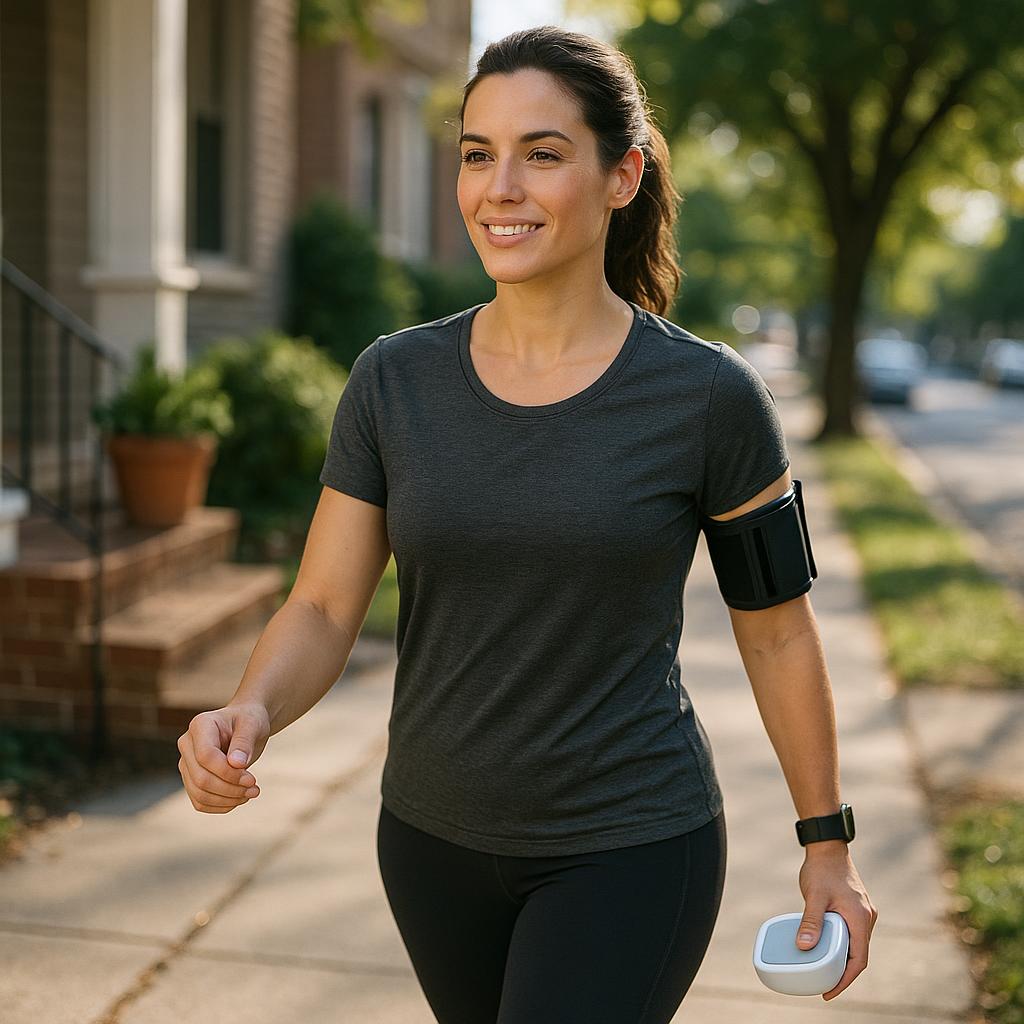
You don’t need a new personality to improve blood pressure.
Most people think the options are binary:
- medication forever, or
- a total lifestyle overhaul you’ll “start next week.”
But the evidence for a third option—brisk walking—is strong enough to take seriously, especially if your blood pressure is already elevated.
A 2024 systematic review and meta-analysis focused on people with hypertension found that brisk walking interventions significantly reduced systolic blood pressure on average, with smaller (and less consistent) effects on diastolic blood pressure. (Malem et al., 2024)
This isn’t a magical cure, and it doesn’t replace medical care. But it is a rare combination of:
- low cost
- low friction
- measurable
- broadly safe for most people
This post is a grounded, skeptical guide to what “brisk walking for blood pressure” actually means, how to do it without turning your life into a new project, and a simple plan you can try today.
What counts as “brisk” (and why the definition matters)
“Brisk” is not a vibe. It’s a physiological intensity.
A useful rule of thumb is the talk test:
- Too easy: you could sing.
- Brisk / moderate: you can talk in full sentences, but you don’t feel like you want to.
- Too hard: you can only get out a few words at a time.
Brisk walking lands in that middle zone: elevated heart rate, slightly deeper breathing, but still sustainable.
Why it matters: many studies don’t test “any walking.” They test walking that’s long enough and intense enough to shift cardiovascular signals—vascular tone, endothelial function, and autonomic balance—without requiring a gym.
What the 2024 meta-analysis actually found
The 2024 review by Malem and colleagues looked at brisk-walking interventions in people with hypertension and pooled results from studies published between 2018 and 2023.
Their headline result: systolic blood pressure decreased meaningfully in the brisk-walking groups compared with controls. (Malem et al., 2024)
A few important nuances that keep this honest:
1) Meta-analyses are averages. Some people respond a lot; some barely respond. 2) Study designs vary. Frequency, duration, supervision, and adherence differ across trials. 3) Diastolic changes were less clear. That’s common in exercise literature: systolic tends to be more responsive.
The pragmatic takeaway is not “walking fixes hypertension.” It’s:
> If you’re trying to move your blood pressure in the right direction, brisk walking is a credible lever—especially because you can actually do it consistently.
The overlooked lever: breaking up sitting (even if you already work out)
One trap is treating blood pressure as a “workout-only” problem.
But a growing body of research suggests prolonged, uninterrupted sitting can acutely raise peripheral blood pressure—and that short activity interruptions can blunt that rise.
A 2024 review in Sports Medicine summarized evidence that an acute bout of prolonged sitting increases peripheral blood pressure, and that interrupting sitting with light activity can offset the increase. (Adams et al., 2024)
This matters for busy people because it reframes the goal:
- not only “do a 30-minute workout,” but also
- “don’t let your body stay in the same inactive state for 4 straight hours.”
If you already walk or train but sit most of the day, you may be leaving easy gains on the table.
Why walking can lower blood pressure (without hype)
You don’t need a single “mechanism” for brisk walking to be useful. Real physiology is multi-causal.
A few plausible, non-magical pathways:
- Vascular function: Repeated moderate-intensity activity can improve endothelial function and arterial compliance.
- Autonomic balance: Walking can nudge the nervous system away from chronically “on” sympathetic tone.
- Body weight and insulin sensitivity: Not required for benefit, but often a helpful co-traveler.
- Stress buffering: Not in a woo way—more in a “short circuit the loop of sitting → tension → coffee → worse sleep” way.
Even if you don’t feel stressed, your physiology still has an “idle mode.” Walking is a way to change that mode.
Do this today (10–20 minutes): the “BP Walk” mini-plan
This is designed to be doable on a normal day. No gear, no ideal route.
The 3–12–3 plan (about 18 minutes)
1) 3 minutes: ramp in
- Walk easy.
- Let your breathing and stride settle.
2) 12 minutes: brisk walking
- Use the talk test.
- If you can’t hold a sentence, back off slightly.
3) 3 minutes: ramp out
- Slow down.
- Let your heart rate come down naturally.
That’s it.
If 18 minutes feels like too much
Use the minimum effective version:
- 6 minutes brisk (plus 1–2 minutes easy at each end).
The point is to build the habit. Once it exists, you can scale the dose.
How often should you do it?
If your goal is blood pressure, consistency tends to beat heroics.
A sane target:
- Most days (4–6 days/week),
- at a “brisk but sustainable” pace,
- for 10–30 minutes total.
If you like clean rules, start with:
- 5 days/week,
- ~15–20 minutes.
You can still lift, run, or do other cardio. Brisk walking is just the easiest default that most people will actually repeat.
Make it frictionless: the two decisions you should pre-make
People fail at “exercise” less because they’re lazy and more because they keep forcing themselves to decide the same thing over and over.
Pre-make these:
1) Your route
- One loop you can do on autopilot.
- If weather is bad, an indoor backup (stairs, hallway, parking garage).
2) Your trigger
- After coffee.
- After lunch.
- After you close your laptop.
Make the walk the default next step after something that already happens.
What to be honest about
A few caveats that keep this trustworthy:
- If you have hypertension, talk to a clinician. Walking is helpful, but it’s not a substitute for evaluation—especially if your readings are high.
- Measure correctly. Home blood pressure measurement has rules (rest, cuff size, timing). Garbage measurement creates garbage conclusions.
- Expect gradual change. Some effects are acute, but the durable shift is usually weeks-to-months, not days.
A calm way to think about the goal
If blood pressure makes you anxious, you’re not alone. Numbers can turn into judgment.
A better framing is:
- you’re building a daily behavior that makes good physiology more likely, and
- you’re stacking enough repetitions that the average trend moves in your favor.
Brisk walking is not dramatic. That’s the point.
Sources
Primary / peer-reviewed:
- Malem R, Ristiani R, Ali Puteh M. Brisk Walking Exercise Has Benefits of Lowering Blood Pressure in Hypertension Sufferers: A Systematic Review and Meta-Analysis. Iran J Public Health (2024). https://pubmed.ncbi.nlm.nih.gov/39444461/
- Adams NT, Paterson C, Poles J, Higgins S, Stoner L. Interrupting prolonged sitting and blood pressure: evidence summary. Sports Med (2024). https://pubmed.ncbi.nlm.nih.gov/37682412/
Guidance / reputable references:
- CDC. High Blood Pressure. https://www.cdc.gov/bloodpressure/
- American Heart Association. Walking. https://www.heart.org/en/healthy-living/fitness/walking