
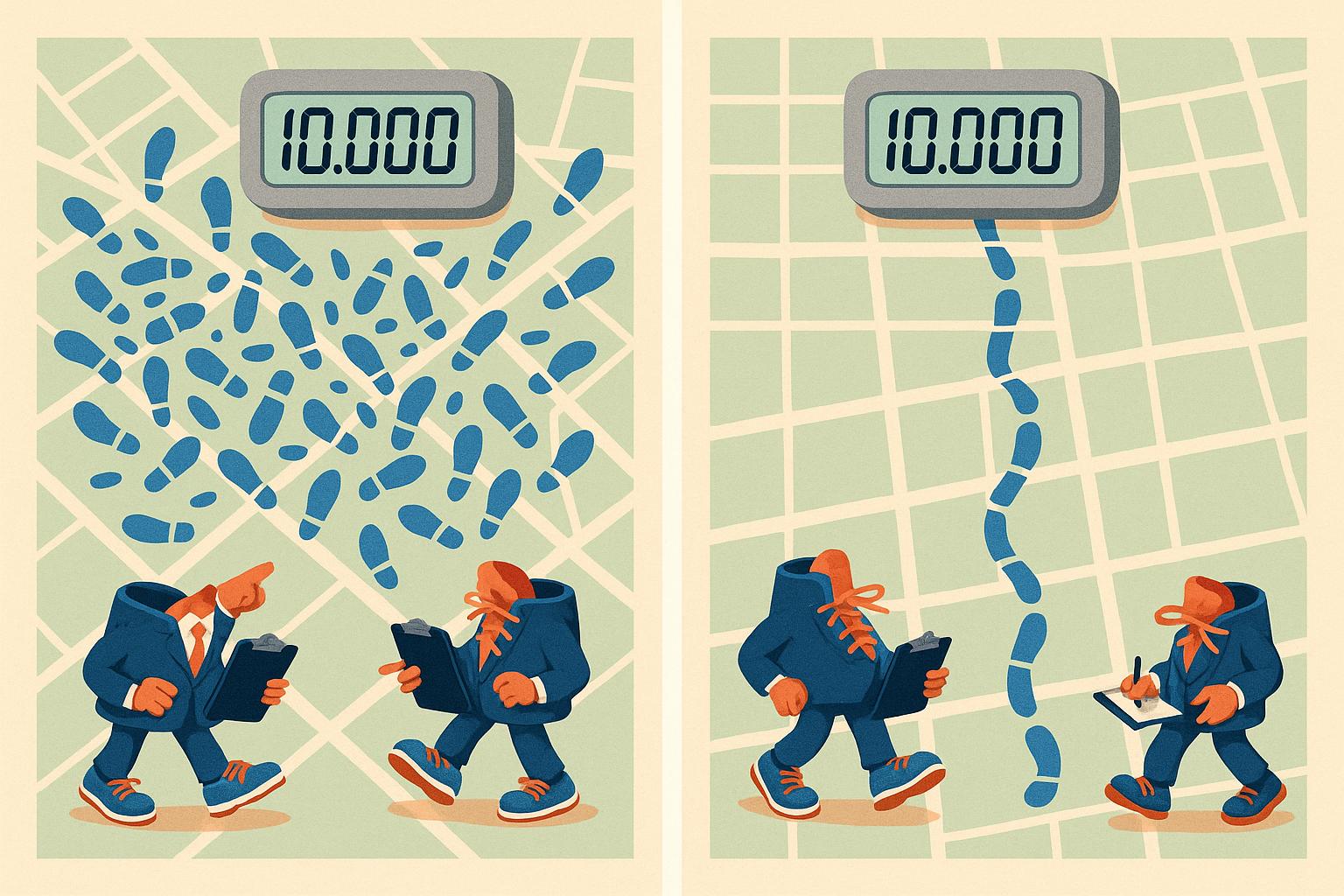
If you’ve ever had two days with roughly the same step count — and one felt energizing while the other felt like you barely moved — you’re not imagining it.
A 2025 study of people undergoing outpatient chemotherapy suggests that activity fragmentation (how chopped-up your movement is across the day) and peak walking cadence (your quickest sustained stepping) add information beyond step count alone. That’s a specific population with specific risks — but the signal is hard to ignore: step count is only one dimension of movement.
This post explains what activity fragmentation is, why it might matter to your day-to-day health, and how to use the idea without turning your life into an optimization project.
The study that put “activity fragmentation” on the radar
The paper: Low et al., 2025 in JCO Clinical Cancer Informatics followed 213 adults receiving outpatient chemotherapy for solid tumors who wore a consumer wearable for up to 90 days. Over a median follow-up of about 2.5 years, 42% of participants died.
In their analyses, three wearable-derived measures were associated with mortality risk:
- Higher step count was associated with lower mortality risk.
- Faster peak gait cadence was associated with lower mortality risk.
- Less activity fragmentation was associated with lower mortality risk.
Importantly, the associations for cadence and fragmentation persisted even after adjusting for factors like cancer type/stage and clinician-rated performance status.
Primary source: Low CA, Bartel C, Durica K, et al. Consumer Wearable Device Measures of Gait Cadence and Activity Fragmentation as Predictors of Survival Among Patients Undergoing Chemotherapy. JCO Clin Cancer Inform. 2025. https://pubmed.ncbi.nlm.nih.gov/40644640/ DOI: https://doi.org/10.1200/CCI-25-00111
What this study does not prove
It’s tempting to read a study like this and jump to: “If I walk in fewer, longer bouts and hit a faster pace, I’ll live longer.” That would be an overreach.
This is an observational study in a high-risk clinical population. Wearable patterns could be acting as a proxy for many things: symptom burden, treatment toxicity, inflammation, anemia, pain, sleep disruption, mood, nutrition, and more. The wearable isn’t causing outcomes — it’s measuring something real about function.
But for a busy, skeptical reader, that’s still useful. Because proxies can be actionable.
What is activity fragmentation (in plain English)?
Think of activity fragmentation as a description of how continuous your movement is.
Two people can both log 7,000 steps:
- Person A gets most of them in one 25-minute walk and a few normal errands.
- Person B gets them in dozens of tiny bursts: 30 seconds here, 90 seconds there, a lap to the printer, a quick trip to the kitchen.
Both days “count,” but they stress the body differently — especially the heart, lungs, muscles, and blood sugar regulation systems that respond to sustained demand.
Fragmentation is also a sneaky marker of constraints. Highly fragmented movement can reflect that you can’t comfortably sustain activity (fatigue, pain, breathlessness), or that your day structure never allows it (back-to-back meetings, caregiving, commuting).
Why cadence shows up alongside fragmentation
Walking cadence is simply steps per minute. Peak cadence isn’t your average pace — it’s your quicker stepping at some point in the day.
Why might it matter?
- Cadence is a proxy for intensity. A brisker pace generally challenges the cardiovascular system more than slow strolling.
- Peak cadence can reflect reserve — the ability to “shift gears” briefly when needed.
Many people dislike intensity talk because it can feel like fitness hype. Cadence is refreshingly concrete: it’s not “crush it.” It’s “walk a little faster for a little while.”
How to use this idea without getting weird about it
Here’s the grounded takeaway:
1) Step count is a useful baseline. It’s simple and it works for many people.
2) If you’re already getting steps, the next lever isn’t necessarily “more.” It may be “less fragmented.”
3) A small, repeatable bout can be the difference. Not because it’s magical — but because it changes your movement pattern from “all crumbs” to “crumbs plus one real slice.”
This aligns with mainstream public health guidance that encourages people to build aerobic activity gradually in realistic ways (CDC: https://www.cdc.gov/physical-activity-basics/about/index.html).
Do this today (10–20 minutes): the “one unbroken block” plan
If your week is chaotic, don’t start with a daily target that depends on perfect scheduling. Start with one unbroken block — a single bout that’s long enough to feel like a session, not a scramble.
The mini-plan
Total time: 10–20 minutes
- Pick a window you can protect: before your first meeting, right after lunch, or during the last phone call of the day.
- Walk easy for 3 minutes. This is your warm-up.
- Walk “comfortably brisk” for 4–10 minutes. You can still talk, but you’d rather not give a speech.
- Finish easy for 2 minutes. Let your breathing come down.
If you track cadence, treat this as a gentle “peak cadence opportunity.” If you don’t, no problem — brisk is a feeling.
Two practical options when you can’t leave
- Indoor loop: pick a hallway/stairwell route where you won’t have to stop every 30 seconds.
- Errand upgrade: turn a necessary task into your unbroken block (park farther once; take the long route once; walk to pick up something small).
The point isn’t perfection. It’s giving your day a single continuous bout so your movement pattern isn’t entirely fragmented.
If your movement is highly fragmented for health reasons
Sometimes fragmentation isn’t a time-management issue — it’s a symptom.
If you notice you can’t sustain even 5–10 minutes without unusual breathlessness, dizziness, chest pain/pressure, new palpitations, or severe fatigue, treat that as a medical signal, not a motivation problem.
For many people — especially older adults — it’s also reasonable to think in terms of capability-building: balance, strength, and aerobic work together. NIH’s National Institute on Aging has practical, no-drama guidance on getting started and staying consistent: https://www.nia.nih.gov/health/exercise-and-physical-activity
A small Steps note (optional)
If you use a step tracker, try looking beyond the total:
- Did you get at least one sustained bout today?
- Was there a moment where you walked a little faster than usual?
Those questions are often more motivating than chasing a bigger number.
The calm conclusion
A decade of “move more” messaging has made many people feel like the only thing that matters is the total.
Newer wearable research is nudging the conversation in a better direction: how you accumulate movement may carry information that a single daily number can’t. You don’t need to chase a perfect cadence or engineer your whole day.
Just give yourself one unbroken block — and let the rest of your steps be whatever life allows.
If you can do that today, you’re not just adding steps. You’re changing the shape of your day.
Sources
- Low CA, Bartel C, Durica K, et al. Consumer Wearable Device Measures of Gait Cadence and Activity Fragmentation as Predictors of Survival Among Patients Undergoing Chemotherapy. JCO Clin Cancer Inform. 2025;9:e2500111. https://pubmed.ncbi.nlm.nih.gov/40644640/
- CDC. Physical Activity Basics and Your Health (updated Dec 3, 2025). https://www.cdc.gov/physical-activity-basics/about/index.html
- NIH National Institute on Aging. Exercise and physical activity. https://www.nia.nih.gov/health/exercise-and-physical-activity
- American Heart Association. Fitness / Walking. https://www.heart.org/en/healthy-living/fitness
DOI: https://doi.org/10.1200/CCI-25-00111